US Spy Satellite USA 32 Breaks Apart 775 km Above Earth After 38 Years in Orbit
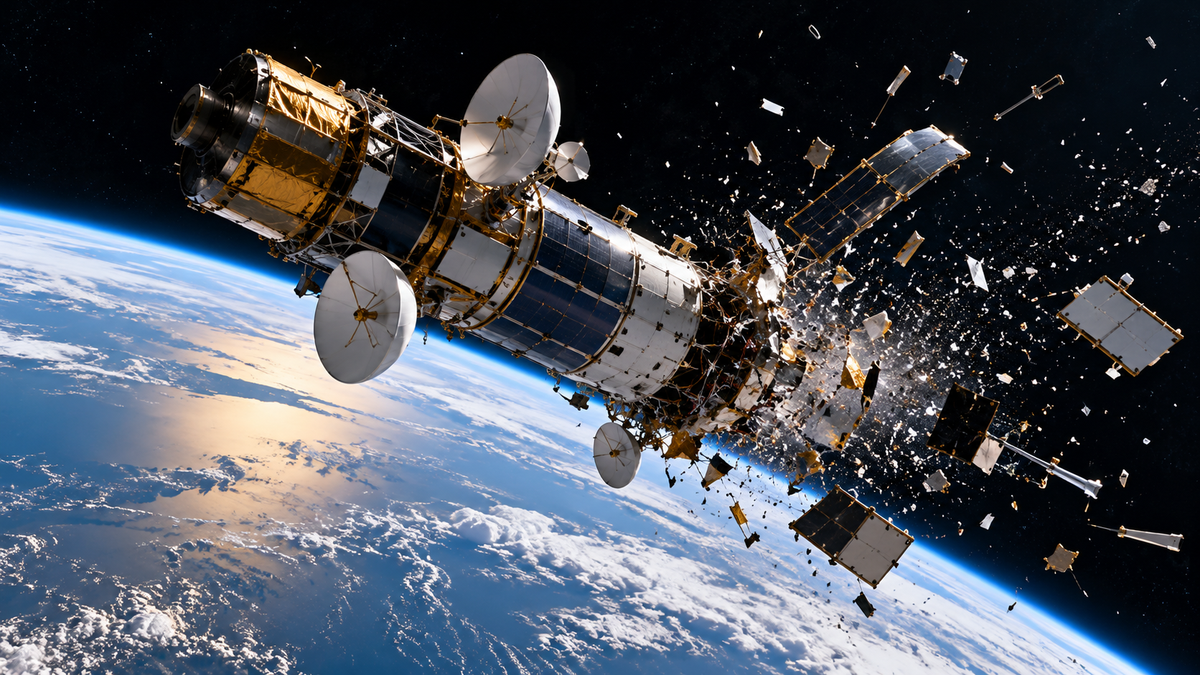
U.S. Cold War-era intelligence satellite launched in 1988 has broken apart in low Earth orbit, adding new debris to an already crowded region of space. The spacecraft, catalogued as USA 32 and identified by analysts as FARRAH III, fragmented on September 13, 2026, at an altitude of approximately 775 kilometres (481 miles).
U.S. Space Forces–Space confirmed the event and said tracked debris would be incorporated into routine assessments used to identify potential collision risks. The agency reported that no immediate threats had been identified, while further analysis remained underway. KeepTrack’s record of the official fragmentation notice reproduces the confirmation and event details.
A Secret Satellite Built to Monitor Soviet Radar
USA 32 was part of a U.S. National Reconnaissance Office programme designed to collect electronic intelligence. During the Cold War, satellites in this category monitored radio-frequency emissions from ground-based systems, including military radars, helping intelligence analysts understand the capabilities and activities of potential adversaries.
The spacecraft is associated with the FARRAH series of signals-intelligence satellites. Declassified programme material describes the later-generation FARRAH spacecraft as larger and more capable than their predecessors, with additional antennas and onboard processing equipment.
According to space historian Dwayne A. Day’s research published by The Space Review, FARRAH III was designed to process some intelligence data onboard and transmit information directly to users, including ground stations and ships. The programme’s broader history illustrates how U.S. military satellite systems evolved to provide intelligence more directly to operational forces.
Why Was It Called FARRAH III?
The FARRAH designation has been widely associated with American actress Farrah Fawcett. The programme also used names such as RAQUEL and URSALA for other signals-intelligence satellites. These names were part of a broader naming tradition within classified intelligence programmes, although publicly available documentation does not conclusively establish the reasoning behind every name.
The satellite itself had a compact, cylindrical design. Illustrations released by the National Reconnaissance Office show the later FARRAH spacecraft with several dish antennas and additional antenna elements. The design was intended to collect electronic signals across multiple frequency bands.
The spacecraft’s precise operational history remains partly classified. Public information does not establish exactly when USA 32 stopped performing its intelligence mission.
Launched on a Titan II Rocket in 1988
USA 32 launched from Vandenberg, California, on September 5, 1988, aboard a Titan II launch vehicle. Its public catalogue number is 19460, and its international designation is 1988-078A.
FARRAH III was reportedly designed for a nominal mission lifetime of approximately three years. However, the satellite remained in orbit for decades beyond that planned period. Research published by The Space Review on the FARRAH satellite programme notes that FARRAH III and another later-generation spacecraft were still observed spinning in orbit in 2021.
Continued orbital presence does not, by itself, prove that a satellite remains operational. It does show how long a spacecraft can persist in space after its intended mission has ended.
What Caused the Satellite to Break Apart?
The cause of the September 13 fragmentation has not been publicly confirmed. The official notice establishes that the breakup occurred, but it does not identify a collision, internal explosion or other specific mechanism.
Age-related hardware failure is one possible explanation for a spacecraft that spent decades in orbit. A failure involving a pressurised component or battery could potentially cause fragmentation. A collision with orbital debris or a small natural object is another possibility. These remain hypotheses rather than established findings.
There is no publicly verified evidence that USA 32 was deliberately destroyed or targeted by an anti-satellite weapon. Without additional technical evidence, attributing the event to a specific cause would be premature.
New Debris Adds to the Orbital Tracking Challenge
When a satellite fragments, the resulting objects can spread along its orbital path. Each sufficiently trackable fragment becomes another object that space-surveillance systems may need to monitor.
At an altitude of roughly 775 kilometres, atmospheric drag is relatively weak compared with lower orbits. As a result, some fragments could remain in space for a long time, although their individual lifetimes will depend on their size, shape, mass and resulting orbits.
According to OKAPI’ analysis of the USA 32 fragmentation, the number of fragments and the physical details of the breakup remain uncertain because public information about the satellite’s design and orbit is limited.
Space Forces–Space said tracked debris would be incorporated into routine conjunction assessments. These assessments help satellite operators identify potentially close approaches and evaluate whether action may be needed to protect spacecraft.
A Cold War Legacy in an Increasingly Crowded Orbit
USA 32’s breakup is a reminder that the end of a satellite’s mission does not mean the end of its presence in space. Spacecraft launched decades ago can remain in orbit long after their operators stop using them, creating continuing monitoring requirements.
Although the cause of USA 32’s fragmentation remains unknown, the event has renewed attention on the long-term consequences of operating spacecraft in orbit. Nearly four decades after its launch, the satellite’s final chapter has become another issue for those responsible for keeping space operations safe.
Author: Kevin Macmellon